
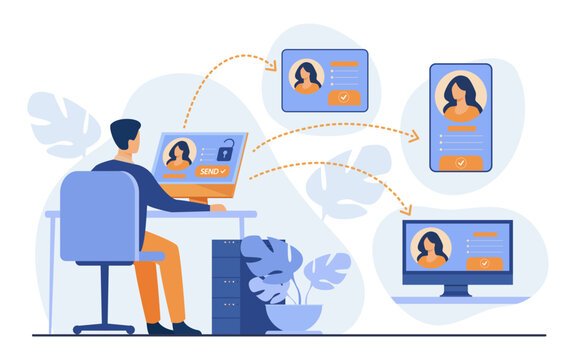
The Importance of Developing Businesses to Operate Remotely: The Future of Work in the Digital Age

Introduction
In recent years, the world has witnessed a profound transformation in the concept of work. The traditional office is no longer the sole hub for productivity and innovation.
After the COVID-19 pandemic, companies realized that remote work is not just a temporary solution — it is a new and sustainable business model.
Transforming businesses to operate remotely is no longer a technological choice but a strategic necessity to ensure continuity, enhance efficiency, and attract top talent from around the world.
1. Digital Transformation as the Foundation for Remote Work
Remote work is fundamentally built on digital transformation, which means shifting traditional processes into automated digital systems.
This includes:
-
Using cloud computing for file storage and management.
-
Relying on collaboration platforms such as Microsoft Teams and Slack.
-
Strengthening cybersecurity systems to protect company data while working from home.
Organizations that adopted digital transformation early on were the ones best equipped to survive crises and expand globally without the need for physical offices.
2. Benefits of Developing Businesses to Operate Remotely
A) Reduced Operational Costs
Remote work significantly lowers expenses related to offices, utilities, and commuting.
Companies can redirect these savings toward innovation and technological development.
B) Access to Global Talent
By operating remotely, organizations can hire top talent regardless of location, increasing diversity, creativity, and innovation within teams.
C) Higher Productivity
Studies show that remote employees often achieve higher productivity levels due to greater flexibility, lower stress, and improved work-life balance.
D) Environmental Sustainability
Reducing daily commutes and office space leads to lower carbon emissions, making remote work an environmentally friendly business model.
3. Challenges and Solutions
Despite its advantages, remote work presents several challenges, including:
-
Weakened team communication.
-
Difficulty in performance monitoring.
-
Information security risks.
To overcome these, companies must:
-
Adopt clear and flexible policies for remote work management.
-
Invest in performance tracking and instant communication tools.
-
Train employees in digital literacy, time management, and self-discipline.
4. The Strategic Role of Leadership
The success of remote business transformation depends not only on technology but also on effective leadership.
Leaders must:
-
Build a culture of trust and accountability.
-
Encourage virtual collaboration and transparency.
-
Redesign workflows to suit the digital environment.
In the remote era, a leader is no longer just a supervisor — but a facilitator of communication and an inspirer of innovation.
5. The Future of Business in the Digital World
It is projected that over 50% of global jobs will be remote-capable within the next decade.
Companies that develop their digital systems and embrace flexible work models will be:
-
More competitive in global markets.
-
More adaptable to economic shifts.
-
More attractive to the new generation of digital professionals.
Thus, remote work is becoming a core pillar of future business success, not merely a short-term trend.
Conclusion
Developing businesses to operate remotely represents a strategic leap toward a more efficient and sustainable future.
It empowers organizations to expand globally, reduce costs, boost productivity, and support environmental and social balance.
In a world driven by rapid innovation, companies that invest today in digital transformation and flexible work models will become the leaders of tomorrow’s economy.